EPISODE 23 / FREE LESSON
SaaS funnel analysis
Where Exactly Is This SaaS Losing Customers?
A funnel is useful when every stage has a clear definition and a comparable denominator. Use Taploop to reconstruct the journey, check the data, and choose the stage where improvement is both meaningful and feasible.
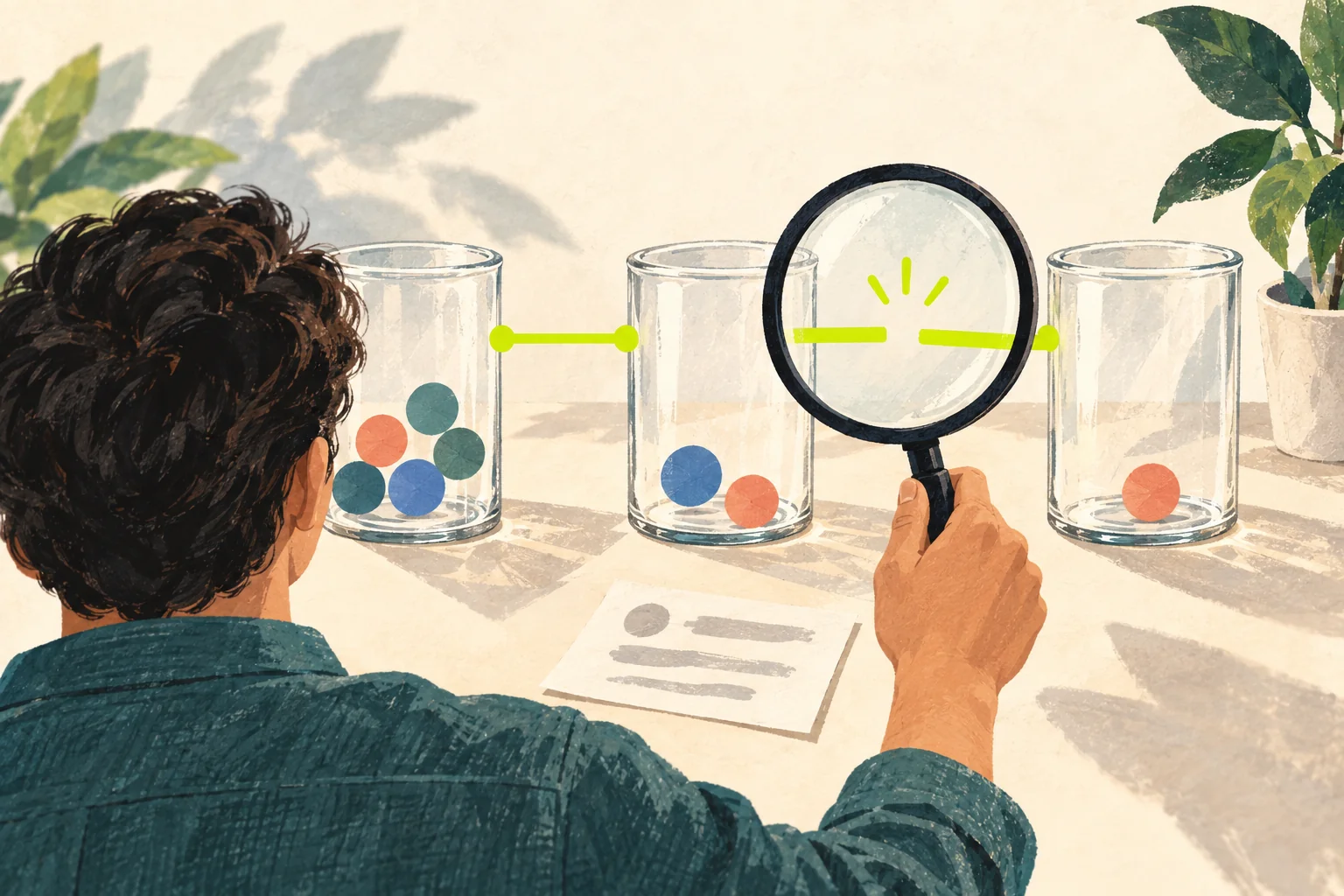 TAPLOOP GROWTH LAB / EPISODE 23
Video coming soon
The written lesson is ready below.
THE GROWTH QUESTION
Unknown funnel bottleneck
A trustworthy funnel explains the journey and its gaps before it produces a percentage.
What you’ll learn
- Define stages using observable events.
- Compare cohorts with enough time to progress.
- Prioritize a bottleneck using impact and evidence.
BEFORE YOU START
Bring the evidence you have.
- The expected visitor-to-customer journey
- Event or CRM records with dates
- Definitions of qualification, activation, and payment
- Known data gaps and recent product changes
Use information you have permission to share. If a data source isn’t connected, provide a relevant export or ask Taploop to work from the evidence available.
WORK THROUGH IT WITH TAPLOOP
From question to a testable plan.
- 01
Write the stage definitions
Ask Taploop to describe each stage as an observable action, with who is eligible and when it is counted. Separate events from unique people or accounts. Check duplicate records, time zones, and whether assisted sales and self-service paths should be analyzed separately.
- 02
Build comparable cohorts
Use available exports or connections to calculate progression for groups that have had enough time to advance. Keep missing tracking distinct from confirmed drop-off. Recent signups should not be treated as failed conversions before their normal decision period has elapsed.
- 03
Choose one stage to investigate
Compare the size of each drop with customer value, likely causes, and the team’s ability to improve it. Ask Taploop to propose a focused qualitative or quantitative check. The largest percentage drop is not automatically the most valuable problem to solve.
MAKE IT YOURS
A prompt to try with Taploop
Add your company’s context and supporting evidence, then use this with your AI agent connected to Taploop.
Build a reliable funnel from these records. Define each stage, eligible population, unique unit, time window, and data limitations before calculating progression. Separate self-service and sales-assisted paths if needed. Identify the most decision-relevant bottleneck using volume, value, evidence, and feasibility, then propose one focused investigation or experiment. Do not fill missing events with assumed behavior.
YOUR EXPERIMENT BRIEF
Improve one funnel transition
Adapt this proposed test to your company. Set the baseline and decision rule before launch.
- Hypothesis
- A specific supported obstacle is preventing eligible people from reaching the next meaningful stage.
- One action
- Apply one approved change at the chosen transition and track a comparable cohort through the next stage.
- Measure
- Next-stage completion among eligible people, with downstream quality and time-to-progress as guardrails.
- Review window
- Allow the normal transition period and enough observations to interpret the result.
- Decision rule
- Keep the change if progression and quality improve. Repair measurement first if the stage counts cannot be trusted.
Review the audience, message, owner, budget, and measurement plan. Publishing, outreach, and spending require your approval.
THE FOLLOW-UP
The real-world experiment
The featured company and experiment are still to come. When this episode is produced, this section will include the starting point, the approved action, and a follow-up with measured results.